

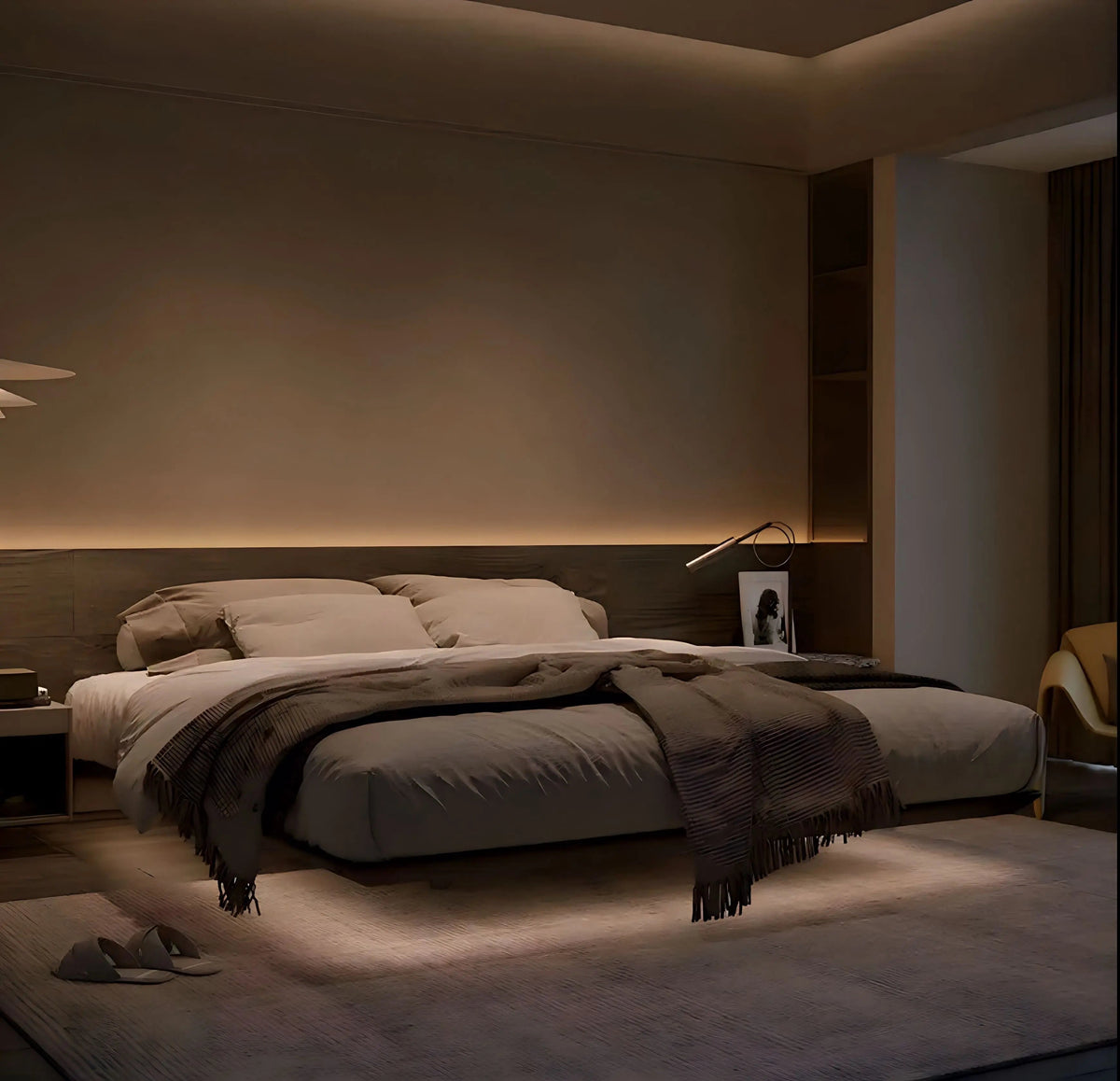
Quick answer: A Japanese-style low bed is either a floor bed, where a futon or mattress lies directly on the floor, or a platform bed, where the mattress sits on a low wooden or upholstered frame. Floor beds suit people who like a firm surface and are happy to air the mattress often. Platform beds suit most people: they keep the calm, grounded look while being easier to get in and out of, and they let air move under the mattress.
Key takeaways
- A floor bed is the traditional Japanese way to sleep; a platform bed is the modern, everyday version of the same idea.
- Low beds make a room feel larger and calmer because they leave more open wall above them.
- Air flow matters: a mattress on the floor needs lifting and airing, while a slatted platform base breathes on its own.
- If getting up from a low height is hard for you, choose a low platform rather than a mattress on the floor.
- Low beds can still hide storage, so you do not have to give up space to get the look.
What is a Japanese-style low bed?
It is any bed that keeps the mattress close to the floor, following the Japanese tradition of sleeping at ground level.
In a traditional Japanese home, people sleep on a futon: a thin, padded mattress laid on tatami mats at night and folded into a cupboard in the morning. The room then becomes a living space again. Few homes outside Japan have tatami floors, so the idea has been adapted into two main forms: the floor bed, which keeps the mattress on the floor, and the low platform bed, which raises it a little on a simple frame.
Both share what makes the style appealing: a low line, very little visual clutter and a feeling of being grounded. That is why low beds sit at the heart of most Japandi interiors, where Japanese restraint meets Scandinavian warmth.
What is the difference between a platform bed and a floor bed?
A floor bed puts the mattress directly on the floor or a thin mat, while a platform bed holds it on a low frame with its own base.
| Floor bed | Low platform bed | |
|---|---|---|
| What it is | A futon or mattress on the floor or on a mat | A mattress on a low frame with a slatted or solid base |
| Height | As low as it gets | Low, but high enough to sit on the edge |
| Getting up | Harder, as you start at floor level | Easier for most people |
| Air flow | Needs regular lifting and airing | Better, especially with a slatted base |
| Cleaning underneath | Lift the mattress to clean | Depends on the gap under the frame |
| Storage | None, unless you fold it away | Some designs hide storage under the mattress |
| Look | Minimal and very relaxed | Minimal and finished, a clear focal point |
Who suits a floor bed?
A floor bed suits people who like a firm sleeping surface, move easily to and from the floor, and do not mind airing their mattress.
Floor beds work well in small flats, studios and guest rooms, where a futon can be folded away to free up the floor during the day. They are also popular with people who simply like the feel of sleeping low and close to the ground.
The trade-offs are practical. Without a frame, nothing lifts the mattress off a cold or damp floor, so moisture can build up underneath. Traditional futons avoid this by being folded and aired every day. A floor bed is also the hardest option to get out of, which matters for anyone with stiff knees, back pain or limited mobility.
Who suits a low platform bed?
A low platform bed suits most people, because it keeps the calm Japanese look while being easier to live with every day.
The frame lifts the mattress enough to sit on the edge, put your feet flat on the floor and stand up. A slatted base lets air circulate, so you do not need to lift the mattress every morning. A platform bed also gives the bedroom a clear focal point, which helps a minimal room feel finished rather than bare.
Platform beds come in two broad styles. Wooden frames bring warmth and texture, like the Mokuzai Bed, which pairs a wooden frame with a rattan headboard. Upholstered frames feel softer and more tailored, like the Kuri Bed, with its low profile and vertically channelled headboard.
What is a floating bed?
A floating bed is a low platform bed whose base is set back from the edges, so the frame seems to hover above the floor.
It is the most striking take on the low bed: you see the mattress and the shadow underneath it, not legs. The Hidemi Bed is one example, made from solid ash wood in a deep black finish, with built-in lighting beneath the frame that casts a soft glow across the floor. That gentle light can also stand in for a bedside lamp late at night.
Can a low bed have storage?
Yes: some low-profile beds hide storage inside the base, so you keep the clean look and a clear floor.
Storage is often the reason people hesitate over a low bed, because there is little room underneath for boxes. A bed with built-in storage solves that. The Eclipse Bed combines a low-profile, rounded frame with an ottoman-style storage area beneath, and the Simupo Bed has a hidden storage compartment under the mattress. Both let you put away spare bedding and out-of-season clothes, which keeps the room calm.
How do you style a Japanese low bed?
Keep everything around it low, natural and simple, so the bed stays the calm centre of the room.
- Match the height: choose low bedside tables, or a small stool or tray, so the surfaces line up with the mattress.
- Use soft, low light: a table lamp on the floor or a low bedside, or light under the bed frame, feels warmer than a bright ceiling light.
- Layer natural textures: linen or cotton bedding, a wool or jute rug, and wood or rattan furniture.
- Stick to a muted palette: warm white, sand, oatmeal and soft grey, with dark wood or black as an accent.
- Leave space: clear floor and bare wall around a low bed are part of the look, not something to fill.
For a full room plan, including bedside tables and lighting, see our guide to Japandi bedroom ideas.
Which should you choose?
Choose a floor bed if you want the most traditional, flexible set-up and are happy to air it; choose a low platform bed if you want the look with everyday comfort.
For most bedrooms, a low platform bed is the practical choice: it keeps the grounded, uncluttered feel, protects the mattress, and is easier to get in and out of. Pick a wooden frame for warmth, an upholstered frame for softness, a floating frame for a statement, or a storage base if space is tight. You can compare the frames side by side in our beds collection.
Frequently asked questions
What is a Japanese-style bed called?
The traditional Japanese bed is a futon: a padded mattress laid on tatami mats and folded away in the morning. Outside Japan, "Japanese-style bed" usually means a low platform bed or a floating bed frame that keeps the mattress close to the floor.
Is sleeping on a floor bed good for you?
Some people find a firm, low surface comfortable, while others find it hard on the hips and shoulders. If you have joint, back or mobility concerns, a low platform bed is the gentler choice, and it is worth asking a doctor or physiotherapist before switching.
Do low beds need a box spring?
No. A platform bed has its own solid or slatted base, so the mattress sits directly on the frame. That is part of why platform beds look so low and clean.
Are low beds hard to get out of?
A very low floor bed can be, because you start almost at floor level. A low platform bed keeps the relaxed, grounded look while lifting the mattress enough to sit on the edge and stand up comfortably.
How do I stop a mattress on the floor from getting damp?
Air flow is the main thing. Traditional futons are folded away and aired every day. If you keep a mattress on the floor, lift it regularly to let it dry, or choose a slatted platform base so air can circulate underneath.
Can I get a low bed with storage?
Yes. Some low-profile beds hide storage under the mattress, such as an ottoman-style base that lifts up. It keeps the low look and the floor clear, which suits a calm Japandi bedroom.

Leave a comment
This site is protected by hCaptcha and the hCaptcha Privacy Policy and Terms of Service apply.