

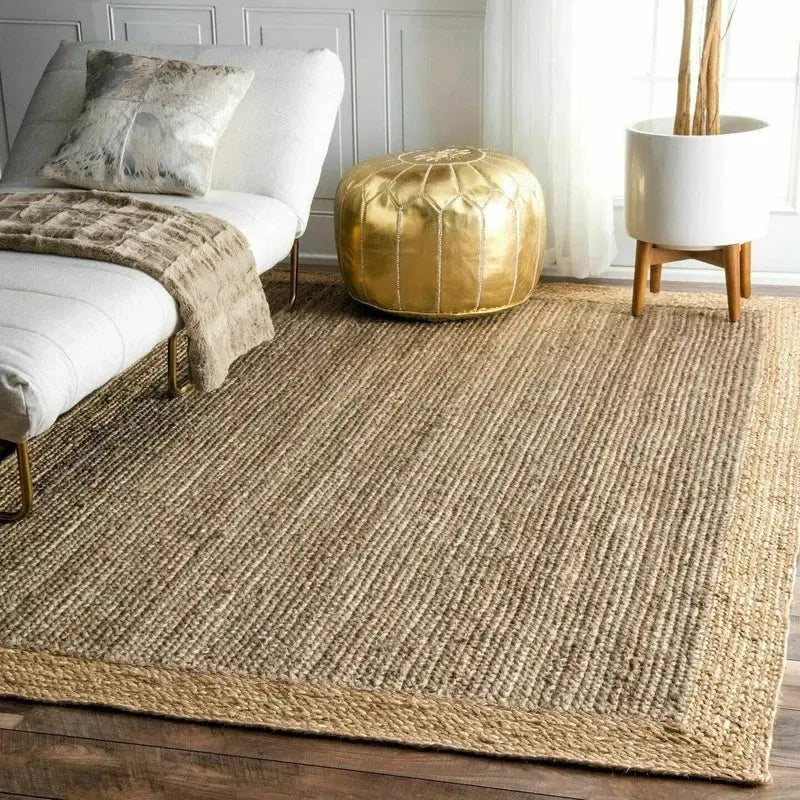
Quick answer: Jute rugs are a hard-wearing, natural and affordable-looking way to add warm texture to a room, and they suit Japandi interiors perfectly. They are best in dry rooms such as living rooms, bedrooms and hallways, feel firmer underfoot than wool, and need gentle, dry cleaning. Choose a size that lets the front legs of your furniture rest on the rug.
Key takeaways
- Jute is durable, textured and naturally neutral.
- It feels firmer than wool, so it is less suited to sitting on the floor for long.
- Keep jute away from damp rooms and clean it dry.
- Living rooms usually need 160 × 230 cm or larger; hallways suit long runners.
- Layering a softer rug over jute adds comfort without losing texture.
What is a jute rug?
A jute rug is woven from jute, a natural plant fibre with a warm, golden-brown tone and a coarse, textured feel.
Jute is spun into thick yarn and woven or braided by hand, which gives each rug a slightly irregular, organic look. That natural texture is why jute sits so well in a Japandi room, alongside wood, linen and rattan. If you are new to the style, our guide to what Japandi style is explains the look.
What are the pros and cons of jute rugs?
Jute is durable, natural and textured, but it is firmer underfoot than wool and does not like moisture.
| Pros | Cons |
|---|---|
| Hard-wearing, good for busy areas | Firmer and coarser underfoot than wool |
| Natural fibre with warm, neutral colour | Can stain or mark if it gets wet |
| Rich texture that suits Japandi and natural interiors | May shed a little at first |
| Easy to layer with softer rugs | Not suited to bathrooms or damp spaces |
Which rooms suit a jute rug?
Living rooms, bedrooms, dining areas and hallways all suit jute; bathrooms and entrances that get wet do not.
- Living room: a large jute rug anchors the sofa and coffee table and adds warmth to a pale floor.
- Bedroom: place it so you step onto it when you get out of bed, or layer a soft rug on top.
- Hallway: a long, narrow runner handles foot traffic and leads the eye down the corridor.
- Dining area: choose a rug large enough for chairs to stay on it when pulled out.
What size jute rug do you need?
Measure the furniture, not just the room: the rug should hold at least the front legs of the main pieces.
In a living room, that usually means 160 × 230 cm or larger, and 200 × 290 cm or more for a bigger seating area. A bedside rug or small reading corner can take a 60 × 90 cm to 90 × 150 cm rug. For a hallway, choose a runner that leaves a little floor showing at each end.
| Rug | Material | Sizes on the product page | Good for |
|---|---|---|---|
| Junya Rug | Jute, geometric pattern | 60 × 90 cm to 240 × 340 cm | Living rooms and bedrooms |
| Harue Rug | Jute, handwoven | 60 × 60 cm to 60 × 365 cm runners, and 90 × 150 cm | Hallways and small spaces |
| Makasi Rug | Jute, braided | 60 × 60 cm to 60 × 360 cm runners | Hallways and kitchens |
| Machine Rug | Jute with a border, black or white | 40 × 60 cm to 60 × 360 cm, and 90 × 150 cm | Entrances and runners |
| Hiyo Rug | Woven jute | 90 × 150 cm | Reading corners and bedsides |
| Initoma Rug | 100% wool, hand woven | 70 × 180 cm to 200 × 290 cm | A softer alternative to jute |
Is jute or wool better for a Japandi room?
Choose jute for texture and a natural, earthy look; choose wool for softness and warmth underfoot.
Jute brings the raw, organic texture that defines Japandi, and it works beautifully under a wooden coffee table. Wool is softer and warmer, which matters if you sit on the floor or want a cosy bedroom. The Initoma Rug is hand woven in 100% wool, 5 to 7 mm thick. You can also layer: a large jute rug underneath with a smaller wool rug on top gives you both.
How do you clean and care for a jute rug?
Keep it dry: vacuum often, blot spills at once, and never soak it.
- Vacuum regularly, ideally without a rotating beater bar, to lift dust and loose fibres.
- Blot spills straight away with a dry cloth; do not rub.
- Spot-clean gently with very little water and let it dry fully.
- Rotate the rug every few months so it wears evenly and fades evenly in sunlight.
- Use a rug pad to stop it slipping and to add a little cushioning.
Our jute rugs are folded for shipping, so they may arrive with creases; these ease with time as the rug settles. See every option in our rugs collection.
Is jute better than sisal or seagrass?
All three are natural fibres; jute is the softest of them, sisal the firmest, and seagrass the most resistant to marks.
Jute has a chunky, slightly soft texture and a warm golden tone, which makes it the most comfortable of the three underfoot. Sisal is tougher and smoother, so it suits very busy areas, but it feels firmer. Seagrass has a smooth, slightly waxy surface that resists marks, though it has less colour variation. For a living room or bedroom where comfort and warmth matter, jute is usually the best choice.
How long does a jute rug last?
With regular vacuuming and kept dry, a well-made jute rug can last for years.
The main things that shorten its life are moisture and grit. Grit wears the fibres down, so vacuuming matters more than with a wool rug, and a rug pad underneath reduces rubbing against the floor. Turning the rug round every few months spreads the wear from feet and furniture.
How do you style a jute rug in a Japandi room?
Let it be the textured base layer, then keep everything on top calm and natural.
Pair jute with pale oak or walnut, linen or bouclé upholstery, and one or two ceramic pieces. A runner in a hallway with a tall mirror at the end makes a narrow space feel brighter. For bedrooms, see our Japandi bedroom ideas.
Frequently asked questions
Are jute rugs good for living rooms?
Yes. Jute is hard-wearing, textured and naturally neutral, so it suits living rooms, bedrooms and hallways. It is best kept away from damp areas such as bathrooms, because natural fibres do not like getting wet.
Do jute rugs shed?
New jute rugs often shed a few loose fibres at first. Regular vacuuming without a rotating beater bar usually settles this within the first few weeks of use.
How do you clean a jute rug?
Vacuum it regularly, blot spills straight away with a dry cloth, and spot-clean gently with as little water as possible. Avoid soaking it or steam cleaning, and let any damp patch dry fully.
What size jute rug do I need for a living room?
Choose a rug large enough for at least the front legs of the sofa and chairs to rest on it. Many living rooms need around 160 × 230 cm or larger; the Junya comes up to 240 × 340 cm.
Why does my new jute rug have creases?
Our jute rugs are carefully folded for shipping, so they may show creases when they arrive. The creases ease with time as the rug settles into your home.
Are Nisu Home rugs made to order?
Every piece is made to order, so timing depends on the piece; its product page shows the current estimate, and you can email hello@nisuhome.com to confirm it before you buy. Before anything ships, we send you photos and videos of the finished piece, and we only ship once you are happy with it.


Leave a comment
This site is protected by hCaptcha and the hCaptcha Privacy Policy and Terms of Service apply.