

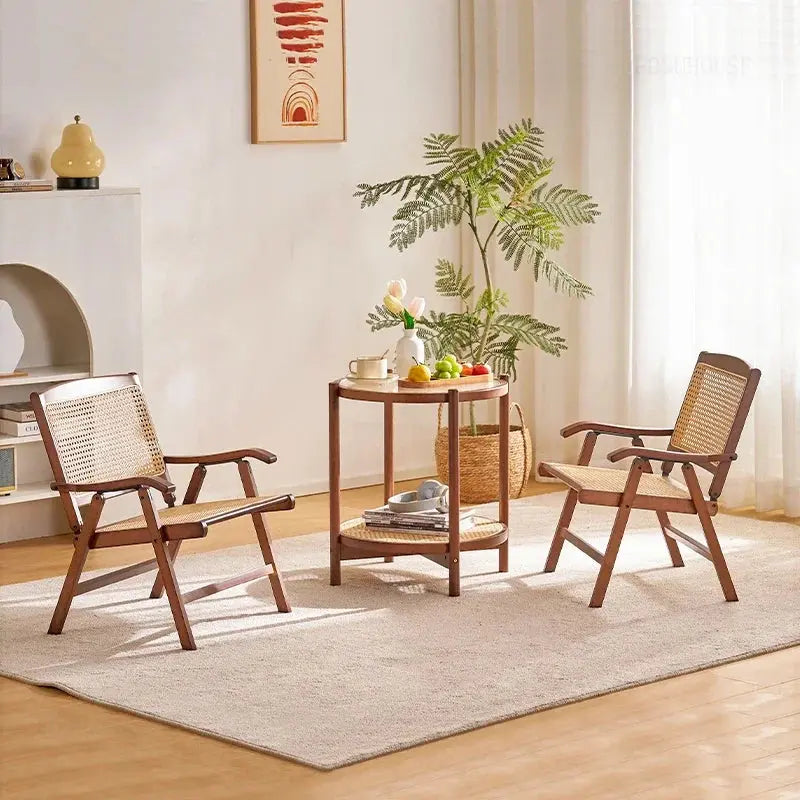
Quick answer: Rattan is a strong, flexible climbing palm used for frames and thick weaves; cane is the thin outer skin of the rattan stem, woven into fine mesh for seats, backs and panels. Both are durable when kept away from heat and damp and dusted regularly, and both bring warmth and lightness to a Japandi room.
Key takeaways
- Rattan is the plant; cane is its thin outer skin, woven into mesh.
- Wicker is a weaving technique, not a material.
- Pieces with a solid wood frame and cane or rattan panels are the sturdiest.
- Clean them dry or barely damp, and keep them away from radiators and rain.
- Pair cane and rattan with oak, walnut, linen and calm neutrals.
What is the difference between cane and rattan?
Rattan is the whole climbing palm stem; cane is the thin, glossy outer skin peeled from it.
Rattan stems are solid, strong and bendable when steamed, so they are used for frames, legs and chunky weaves. Cane is cut from the outer layer into thin strips and woven into the open mesh you see on chair seats and cabinet doors. "Wicker" describes the weaving method itself, which can use rattan, cane, willow or other fibres.
| Rattan | Cane | |
|---|---|---|
| What it is | The stem of a climbing palm | The thin outer skin of the rattan stem |
| Typical use | Frames, legs, thick weaves, headboards | Woven mesh for seats, backs, panels |
| Look | Chunky, rounded, natural | Fine, airy, slightly glossy |
| Feel | Sturdy | Light, with a little give |
Is cane and rattan furniture durable?
Yes. Rattan is naturally strong and flexible, and it lasts well with simple care.
The sturdiest designs combine a solid wood frame with rattan or cane panels, so the wood carries the weight and the weave adds texture. The Natsu Chair, for example, is crafted from solid ash wood with a gently reclined cane back and a hand-woven rattan seat, and folds away easily. The Inamito Chair sets a woven cane backrest and seat on a sturdy wooden frame, with a soft neutral cushion, in black, wood or walnut.
Which cane and rattan pieces suit which room?
Use chairs to bring texture to a dining table, and larger pieces such as a cabinet or headboard to warm a living room or bedroom.
- Dining room: the Hinata Chair has a handwoven rattan thread backrest, a soft upholstered seat and brass-tipped legs; the Akane Chair pairs a sleek frame with a woven rattan backrest in wooden, walnut or black.
- Living room: the Kyoto Cabinet, 180 cm wide, is made from rattan with detailed weaving and generous storage; the Kofuku Coffee Table combines ash wood and rattan in a round shape.
- Bedroom: the Mokuzai Bed has a wooden frame with a rattan headboard, in 1.5 m or 1.8 m.
- Reading corner or balcony: the folding Natsu Chair moves easily between indoors and a covered outdoor space.
How do you clean and care for cane and rattan?
Dust it often, clean it with a barely damp cloth, and keep it away from strong heat and damp.
- Dust weekly with a soft brush or a vacuum brush attachment to clear the weave.
- Wipe gently with a cloth that is barely damp, then let it dry fully in the air.
- Avoid heat: radiators and very strong direct sun can dry out natural fibres.
- Avoid soaking and harsh cleaning products.
- Use the cushion: on seats, a cushion spreads weight and protects the weave.
How do you tell well-made rattan furniture?
Look at the weave, the joints and the ends: good pieces are tight, even and smooth.
- Even weave: the strands should be evenly spaced and tight, with no gaps or loose ends.
- Smooth finish: run a hand over it; there should be no splinters or rough cut ends.
- Solid joints: legs and frame should feel firm, with no wobble when you sit or lean.
- A sturdy frame: a solid wood frame under rattan or cane panels carries weight better than a woven body alone.
Is rattan the same as bamboo?
No. Bamboo is a hollow grass, while rattan is a solid palm stem.
Because rattan is solid and bends when steamed, it can be shaped into curves, which is why it is used for rounded chairs, headboards and pendant shades. Bamboo is straighter and more rigid. Many lamps combine the two: the rattan and bamboo pendant lights in our range pair woven rattan with bamboo or wood.
Can a sagging cane seat be tightened?
Often, yes: natural cane tightens slightly as it dries after being lightly dampened.
The traditional method is to mist the underside of the cane lightly with clean water and let it dry slowly at room temperature, away from heat. It is a gentle fix for natural cane only, and it should never be soaked. If the cane is torn rather than loose, it needs repair by a specialist.
How do you style cane and rattan in a Japandi room?
Treat cane and rattan as your texture, and keep the colours around them calm.
Pair the honey tones of rattan with pale oak or deep walnut, linen or bouclé upholstery, and white or warm grey walls. One or two woven pieces per room are enough; a rattan pendant above a cane-back dining chair, for instance, ties a space together. Mixing finishes works too: a walnut-framed cane chair beside a pale oak table adds depth, as long as the woven texture repeats somewhere else in the room, such as a lamp shade, a basket or a mirror frame. For more on dining rooms, see our Japandi dining room ideas, and browse every piece in our rattan and cane furniture collection.
Frequently asked questions
What is the difference between cane and rattan?
Rattan is a climbing palm whose strong stems are used for furniture frames and thick weaves. Cane is the thin outer skin of the rattan stem, cut into strips and woven into fine mesh for chair seats, backs and panels.
Is rattan furniture durable?
Yes, when it is looked after. Rattan is strong and flexible, and a solid wood frame with rattan or cane panels, as on many of our pieces, adds strength. Keep it away from heat and damp, and dust it regularly.
How do you clean cane and rattan?
Dust with a soft brush or vacuum brush attachment, then wipe with a cloth that is barely damp and let it dry fully. Avoid soaking it, harsh cleaners and placing it right beside a radiator.
Can rattan furniture go outside?
Natural rattan is best kept indoors or in a covered space, away from rain and strong sun. The Natsu Chair is designed for flexible indoor and outdoor use and folds away easily.
Does cane furniture suit a Japandi home?
Very well. Cane and rattan bring warmth, texture and lightness, and pair naturally with oak, walnut, linen and neutral colours, which are the core of Japandi style.
Are Nisu Home rattan pieces made to order?
Every piece is made to order, so timing depends on the piece; its product page shows the current estimate, and you can email hello@nisuhome.com to confirm it before you buy. Before anything ships, we send you photos and videos of the finished piece, and we only ship once you are happy with it.


Leave a comment
This site is protected by hCaptcha and the hCaptcha Privacy Policy and Terms of Service apply.