

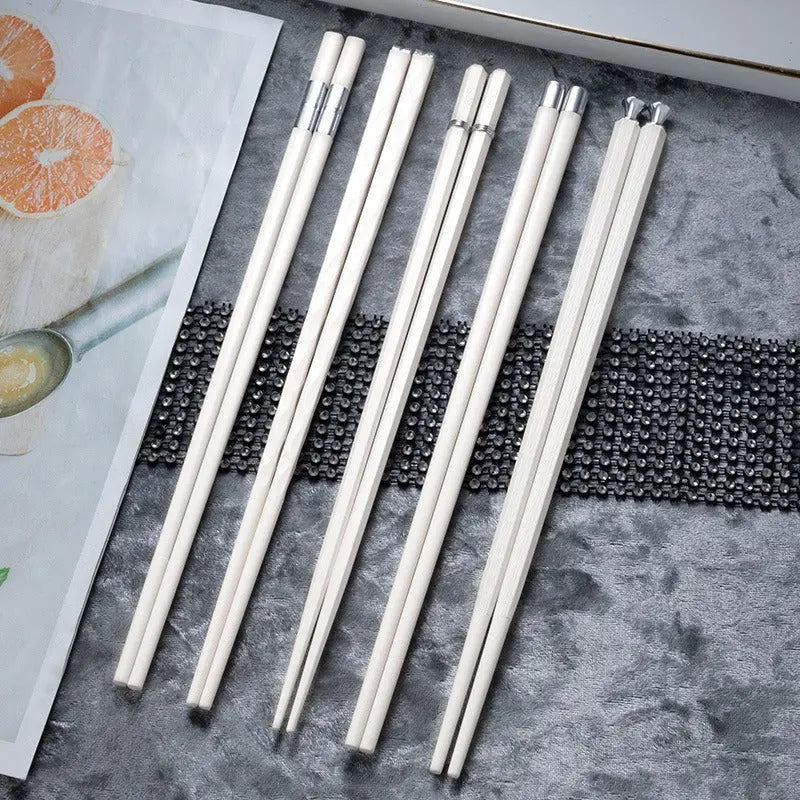
Quick answer: To choose chopsticks, decide on the material first (wood or bamboo for grip, lacquered wood for a smooth, lasting finish, metal or resin for easy cleaning), then the length: about one and a half times the span between your thumb and index finger. Finally, check the tips and the care guide, because those decide how a pair feels and how long it lasts.
Key takeaways
- Wood and bamboo grip food best; metal is the most slippery but the easiest to keep clean.
- The hito-ata-han rule gives a comfortable length for your own hand, usually around 21 to 24 cm for adults.
- Japanese chopsticks taper to fine points, which makes picking up small pieces easier.
- Square or faceted chopsticks roll less and are easier to hold than round ones.
- Hand washing and drying straight away keep most chopsticks looking good for years.
What should you look for when choosing chopsticks?
Look at four things: material, length, tip shape and care. Together they decide whether a pair is comfortable, easy to eat with and practical for everyday use.
It helps to think about how you will use them. A pair for everyday rice and noodle meals needs a good grip and easy cleaning. A pair for guests or a special table can lean more towards looks, with a lacquered or metallic finish that ties in with your plates and bowls. Many households keep both.
If you are building a Japanese table from scratch, our Japanese tableware guide covers the bowls, plates and cups that go with them, along with chopstick etiquette, so this guide focuses on choosing the pair itself.
Which chopstick material is best?
The best material depends on what you value most: grip, looks, weight or easy cleaning. Each common material has a clear trade-off.
| Material | Grip | Feel | Care | Good for |
|---|---|---|---|---|
| Bare wood | Very good | Light and warm | Hand wash, dry straight away | Everyday meals, beginners |
| Bamboo | Very good | Light, slightly textured | Hand wash, dry straight away | Everyday meals, noodles |
| Lacquered wood | Good | Smooth with a soft sheen | Gentle hand wash, no soaking | Special meals, gifts |
| Metal | Lower | Cool and heavier | Easy to clean; check the maker's guide | Durability, hygiene |
| Resin or plastic blends | Fair to good | Light and even | Usually easy to clean; check the guide | Busy households, colour |
Wood and bamboo are the traditional choice in Japan. Their natural texture holds slippery food such as noodles and tofu, and they are pleasant to hold. The trade-off is care: long soaking and high heat can make them crack or warp.
Lacquered wood adds a protective, glossy coat. It looks refined on the table and resists stains, but the lacquer can wear if it is scrubbed hard or put through a hot wash.
Metal chopsticks are durable and easy to keep clean, which is why they are common in Korea. They are heavier and smoother, so they take a little practice.
Mixed designs combine materials to balance looks and practicality. The Tetsu Chopsticks, for example, are made of metallic and PET material and come in sets of five, in black, red, black with gold, light blue and white.
How long should chopsticks be?
A comfortable pair is about one and a half times the span between your thumb and index finger. In Japan this rule of thumb is called hito-ata-han, meaning "one and a half ata".
To measure your ata, stretch your thumb and index finger into an L shape and measure from tip to tip. Multiply by one and a half, and you have a good starting length. Chopsticks that are too short make you grip near the tips and cramp your hand; chopsticks that are too long feel unwieldy and harder to control.
| Type | Typical length | Notes |
|---|---|---|
| Children's chopsticks | Shorter, matched to the child's hand | Often have training rings or grips |
| Japanese adult chopsticks | Around 21 to 24 cm | Smaller hands at the lower end, larger hands at the upper end |
| Chinese chopsticks | Usually longer than Japanese | Blunt tips, made for reaching shared dishes |
| Cooking chopsticks (saibashi) | Much longer, often 30 cm or more | Keep hands away from heat when frying or stirring |
The Tetsu Chopsticks measure 24.3 cm, which suits most adult hands and works well for shared dishes at the table.
What is the difference between Japanese, Chinese and Korean chopsticks?
Japanese chopsticks are shorter with fine, tapered tips; Chinese chopsticks are longer with blunt ends; Korean chopsticks are flat and usually metal. Each shape grew out of the way food is served and eaten.
- Japanese: tapered points help with picking bones out of fish and lifting small pieces from individual dishes.
- Chinese: extra length helps when reaching into shared dishes in the centre of a round table.
- Korean: flat metal chopsticks are paired with a spoon, which does much of the work at a Korean meal.
For a Japandi table, a tapered pair in a calm colour sits naturally beside handmade ceramics.
Do the tips and shape matter?
Yes: the tips decide how well you can grip food, and the body shape decides how comfortable the pair feels. Small details make a big difference over a whole meal.
- Textured or ridged tips hold noodles and slippery food more securely.
- Fine points make it easier to pick up rice and small pieces.
- Square or faceted bodies sit steadily between your fingers and do not roll off the table.
- Weight balance matters: a pair that feels heavy at the top tires the hand more quickly.
How do you care for chopsticks so they last?
Wash chopsticks by hand in warm, soapy water, rinse and dry them straight away. That simple routine suits almost every material and keeps finishes looking new.
- Don't soak them: standing water can swell wood and bamboo and loosen lacquer.
- Check before using the dishwasher: many chopsticks, especially wood, bamboo, lacquered and decorated pairs, should be kept out of it. The Tetsu Chopsticks' care guide recommends a gentle hand wash and avoiding the dishwasher to protect the design and finish.
- Dry them standing up or flat on a cloth, so air reaches every side.
- Replace worn pairs: wooden chopsticks with deep cracks or splinters are hard to keep clean.
How do you style chopsticks on a Japandi table?
Choose chopsticks that echo your tableware, then lay them across the front of each setting on a rest. Calm colours and natural textures keep the table looking considered rather than busy.
White or light blue chopsticks look fresh beside textured ceramics such as the Doshim Tableware, which includes a small 13 × 7 cm bowl and a range of square and rectangular plates in organic shapes and earthy tones. Black or black-and-gold pairs suit darker, glossier pieces, such as the marbled Tora Bowl with its gold rim.
For sushi and dumplings, long plates and a place for sauce help: the Ichi Dishes are serving dishes made for sushi and appetisers, and the Sutekina Plates have a built-in compartment for dipping sauce. Finish the setting with a handleless stoneware cup such as the Usagi Glass for tea.
If guests prefer a knife and fork, a set with natural handles keeps the look consistent. The Nakuti Cutlery pairs stainless steel with bamboo handles. Browse more in our tableware collection, and for meals at a low table, see our chabudai table guide.
Frequently asked questions
What is the best material for chopsticks?
There is no single best material. Wood and bamboo grip food well and feel warm in the hand, lacquered wood is smooth and long-lasting with gentle care, and metal or resin chopsticks are the easiest to keep clean. Choose by how you eat and how you like to wash up.
How long should chopsticks be?
A traditional Japanese guide, hito-ata-han, says a comfortable pair is about one and a half times the distance between your thumb tip and index fingertip when you stretch them into an L shape. For most adults that lands somewhere around 21 to 24 cm.
What is the difference between Japanese, Chinese and Korean chopsticks?
Japanese chopsticks are usually shorter and taper to fine points, which helps with fish and small pieces. Chinese chopsticks are longer with blunt ends, suited to reaching shared dishes. Korean chopsticks are typically flat and made of metal.
Can chopsticks go in the dishwasher?
It depends on the material and the maker. Wooden, bamboo and lacquered chopsticks are best washed by hand, because heat and long soaking can crack or dull them. Always follow the care guide for your pair; the Tetsu Chopsticks, for example, should be hand washed and kept out of the dishwasher.
Are metal chopsticks harder to use?
They can be at first. Metal is smoother and heavier than wood, so food slips more easily. Pairs with textured or squared tips, or a mixed design that is lighter in the hand, are easier for beginners.
How do you stop chopsticks from rolling off the table?
Use a chopstick rest, called a hashioki in Japanese. Square or faceted chopsticks also roll less than round ones.

Leave a comment
This site is protected by hCaptcha and the hCaptcha Privacy Policy and Terms of Service apply.