

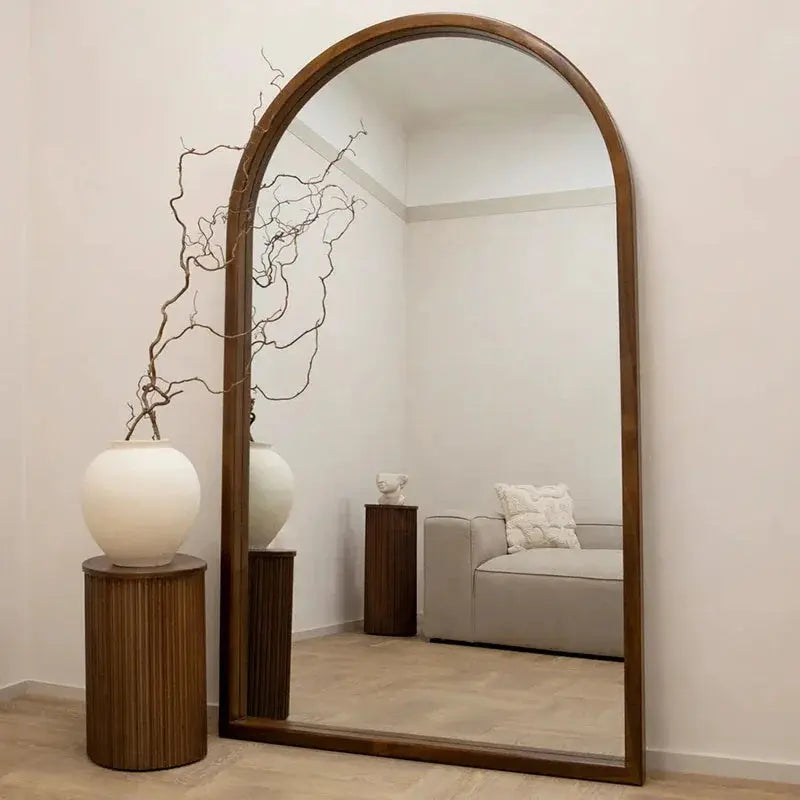
Quick answer: Choose a full-length mirror that is at least half your height, and ideally 160 cm or taller, so everyone in the house can see themselves head to toe. Then pick the frame for the room: a soft arch or organic wooden frame for a calm Japandi bedroom, a wavy frame for a sculptural statement, or a mirror on its own stand if you would rather not fix anything to the wall.
Key takeaways
- At least half your height shows you head to toe; 160 to 200 cm is the easiest size to live with.
- About 60 cm wide suits one person; 80 to 90 cm gives more room to check an outfit.
- Leaning looks relaxed, but always fix a tall leaning mirror to the wall.
- Place it near a window to bounce light, or by the door for a last look before you leave.
- Wood, walnut and rattan frames suit Japandi rooms; wavy and sculptural frames make a statement.
What size full-length mirror do you need?
At least half your height, hung at the right level, and taller if several people will use it.
A mirror only needs to be about half your height to show your whole body, because of the way a flat mirror reflects. The catch is that it has to sit at exactly the right height for you. A taller mirror removes the guesswork: anyone in the house can see themselves from head to toe, and it still works when leaned at a slight angle. That is why most full-length mirrors are 160 cm or taller.
Width matters too. Around 60 cm is enough for one person to check an outfit; 80 to 90 cm feels more generous and makes a bigger impact on the room. In a narrow hallway, a slimmer mirror leaves space to walk past.
Which full-length mirror shape suits your room?
Choose the shape by the mood you want: arched and organic frames feel calm, wavy and sculptural frames feel playful.
- Arched. Straight sides and a rounded top soften a room full of straight lines, and suit bedrooms and hallways alike.
- Organic and curved. A flowing wooden frame echoes natural shapes, which fits the Japandi idea of bringing nature indoors.
- Wavy. A frame that curves in and out along its sides turns the mirror into a piece of wall art.
- Standing. A mirror on its own stand can go anywhere, with nothing to fix to the wall.
If you are new to the style, our guide to what Japandi style is explains why natural materials and soft curves work so well together.
How do the Nisu Home full-length mirrors compare?
All eight come in a size of 160 cm tall or more; here is how their shapes, sizes and frames compare.
| Mirror | Shape | Size (height × width) | Frame |
|---|---|---|---|
| Natsuki Mirror | Tall arch | 180 or 200 × 70 cm | Ash wood, brown or white |
| Nordan Mirror | Arch with rattan border | 180 × 80 cm | Rattan border |
| Kayo Mirror | Arch | 160 × 70 cm | Ash wood, brown or white |
| Okemia Mirror | Curved, organic | 169 × 60 cm | Curved wood |
| Kohana Mirror | Fluid, organic | 160 or 170 cm tall (also 100 and 120 cm); 60 or 90 cm wide | Wood |
| Tochio Mirror | Wave-shaped | 180 × 90 cm | Solid walnut |
| Moniwa Mirror | Wavy, undulating | 160 × 60 cm | Gold finish |
| Chinatsu Mirror | Elliptical frame on a stand | 173 cm tall overall, 46 cm wide | Metal base, black or red |
Which mirror is best for a Japandi bedroom?
A tall arched or organic mirror in natural wood is the calmest choice for a Japandi bedroom.
The Natsuki Mirror is the tallest of the range at 180 or 200 cm, with a minimalist ash wood arch in brown or white; it can stand against a wall or work as a freestanding accent. For a slightly smaller arch, the Kayo Mirror is 160 × 70 cm in the same ash wood finishes. If you prefer a softer, more natural outline, the Okemia Mirror has a beautifully curved wood frame and is made for bedrooms, hallways and dressing areas. For more on pulling the room together, see our Japandi bedroom ideas.
Which mirror makes the biggest statement?
A wavy or sculptural frame turns a practical mirror into the focal point of a room.
The Tochio Mirror has a fluid, wave-shaped frame in solid walnut, 180 × 90 cm, and suits an entryway, living room or bedroom. The Moniwa Mirror pairs an undulating frame with an elegant gold finish. For something closer to sculpture, the Chinatsu Mirror has an elliptical frame that loops around the glass and stands on a sleek metal base, in black or red.
Should a full-length mirror lean or hang?
Lean it for a relaxed look and easy moving, or hang it to save floor space; either way, keep it secure.
A tall mirror leaning against the wall has an easy, unfussy feel and is simple to move between rooms. It also takes up a little floor space, so in a tight hallway hanging it flat may be better. Some mirrors are made to stand on their own: the Chinatsu has a metal base, and for the Okemia you can ask us for a back attachment that allows it to stand.
Whichever you choose, safety comes first:
- Fix leaning mirrors to the wall. An anti-tip strap or bracket near the top stops a tall mirror sliding or tipping.
- Keep the lean shallow. A small gap at the bottom is enough; a steep angle is less stable.
- Use a non-slip pad. It stops the base sliding on wooden or tiled floors.
- Think about children and pets. Busy households should always fix the mirror at the top.
Where should you put a full-length mirror?
Near a window to spread daylight, by the door for a last check, or in the bedroom close to where you dress.
- Beside or opposite a window. A mirror here bounces natural light around the room and makes it feel larger.
- In the hallway. Next to the front door, it is handy for a last look before you go out and brightens a dark space.
- In the bedroom. Near the wardrobe or dressing area, where you need it most.
- At the end of a corridor. A tall mirror here makes a narrow space feel longer and lighter.
Rattan and wood frames bring texture to these spaces. The Nordan Mirror, a tall arch with a rattan border, suits entryways, bedrooms and living rooms, and the Kohana Mirror, with its fluid wooden frame, comes in heights from 100 to 170 cm, so you can choose a full-length size or a smaller wall mirror. See every option in our mirrors collection.
Frequently asked questions
What size should a full-length mirror be?
To see yourself head to toe, a mirror needs to be at least about half your height and hung at the right level. A taller mirror, from 160 to 200 cm, is easier for everyone in the house to use and can also be leaned against a wall.
Should a full-length mirror lean or hang?
Either works. Leaning feels relaxed and is easy to move, while hanging saves floor space and suits a narrow hallway. If you lean a tall mirror, fix it to the wall near the top so it cannot slide or tip.
How do I stop a leaning mirror from falling?
Secure it to the wall near the top with an anti-tip strap or bracket, keep the angle shallow, and stand the base on a non-slip pad. This matters most in homes with children or pets.
Where is the best place to put a full-length mirror?
Beside or opposite a window, where it bounces daylight around the room; in a hallway near the front door for a last look before you go out; or in a bedroom near the wardrobe or dressing area.
What is the difference between a wavy mirror and an arched mirror?
A wavy mirror has a frame that curves in and out along its sides, for a playful, sculptural look. An arched mirror has straight sides and a rounded top, which feels softer and more classic.
Are Nisu Home mirrors made to order?
Yes. Each mirror is made to order for you, and its product page shows the delivery time. Before it ships, we send you photos and videos of the finished piece, and we only ship once you are happy with it.

Leave a comment
This site is protected by hCaptcha and the hCaptcha Privacy Policy and Terms of Service apply.